
Vote for the best verboticism.
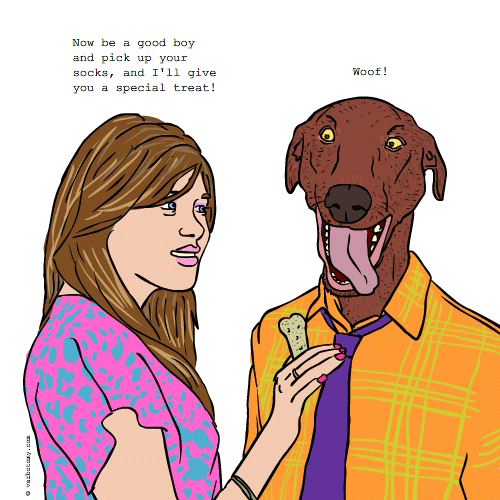
DEFINITION: v. To use animal training techniques to improve and direct the behavior of other people. n. A technique which uses the principles of animal training to solve a human behavioral riddle.
Verboticisms
Click on each verboticism to read the sentences created by the Verbotomy writers, and to see your voting options...
You have two votes. Click on the words to read the details, then vote your favorite.
Beaubedience

Created by: artr
Pronunciation: bōbēdēəns
Sentence: Jill believes in beaubedience. Her boyfriend knows how to behave because she has taught him well. Just last week when he spilled milk on the kitchen counter, she rubbed his nose in it and barked at him. At least she has given up smacking him with rolled-up newspaper.
Etymology: beau (a boyfriend or male admirer) + obedience (compliance with someone\'s wishes or orders or acknowledgment of their authority)
Treaser
Created by: josje
Pronunciation: treaser
Sentence: i am a perfect treaser
Etymology: trainer en teaser
Reinforceman

Created by: mrskellyscl
Pronunciation: re-in-force-man
Sentence: Lia found that Max responded well to positive reinforceman one day by accident when she came home and found the dishes were done. She fussed on him, grilled his favorite steak and bought him a six-pack. Max immediately got up after the meal and did the dishes. Later that night while watching Victoria Stilwell train a Rottweiler on "It's Me or the Dog" she had a revelation. Perhaps she could teach Max to put the toilet seat down if she used a really good reward. She decided to learn some training techniques from Victoria and immediately went to the mall to get a little treat for him from Victoria's Secret.
Etymology: reinforcement + man: in Operant Conditioning reinforcement occurs when an event following a response will increase the likelihood of that response happening again. Animals trained with reinforcement techniques are trained by using treats and praise instead of negative reinforcement. Victoria Stilwell is a dog trainer on Animal Planet who uses reinforcement on ill-mannered dogs.
----------------------------
COMMENTS:
Clever word and story.... - mweinmann, 2009-06-30: 08:03:00
----------------------------
Poochnique
Created by: OZZIEBOB
Pronunciation: POOCH-neek
Sentence: "If you have something to say." Roxie barked, "shut up." She hoped that her poochniques would make Bob think that he had a dog for a wife, and he would forever remain her best friend.
Etymology: Blend of POOCH: slang for dog; etymology unknown, could be from German "Putzi" a name for a lap-dog?? & TECHNIQUE.
Manapulate
Created by: TJayzz
Pronunciation: Man-ayp-yu-layt
Sentence: Pam was hoping that when Bob saw the documentary on how the apes adapted the various things in their surroundings to use as tools, that it may spur him on to getting on with all the little jobs that needed doing around the house
Etymology: Man(Human being) +ape (a large tailess primate) +(manipulate (to cleverly control or influence) =manapulate
Circusitous
Created by: bookowl
Pronunciation: sir/cus/i/tus
Sentence: I used a circusitous route but the leash worked wonders for keeping the kids in check.
Etymology: circus + circuitous (devious)
Henneagram
Created by: galwaywegian
Pronunciation: hen eee aaa gram
Sentence: Her use of the henneagram was richickulous, one fowl idea after another in her so called pursuit of eggselence.
Etymology: enneagram, hen
----------------------------
COMMENTS:
Another eggselent word, no yolks about it. Did you pullet out of the air or is it poultry in motion? - Nosila, 2008-05-19: 17:00:00
----------------------------
Dougwhisperer
Created by: artr
Pronunciation: dəgwispərər
Sentence: Doug's girlfriend is great at getting him to do what she wants by applying the best pet training techniques. A treat here, a scratch behind the ear there. She keeps it all positive, no smack with a rolled-up newspaper here. She is so good at it that her friends call her the Dougwhisperer.
Etymology: Doug () + Dog Whisperer (The Dog Whisperer, Cesar Millan, is a dog trainer who adopts a sympathetic view of the motives, needs, and desires of the dog, based on natural dog behavior and modern dog psychology)
Pavlove
Created by: stache
Pronunciation: pāv'lŭv'
Sentence: Janelle would pavlove Bart every night when he came home without the smell of cigarettes and beer about him; eventually, Bart stopped going to Moe's for drinks after work.
Etymology: Pavlov, Ivan, Russian physiologist who is best known for discovering the conditioned response; love, to have or express affection for another; also, sexual passion or desire.
----------------------------
COMMENTS:
nice! - galwaywegian, 2008-05-19: 14:06:00
Excellent word. Makes me salivate. lol - Mustang, 2008-05-19: 14:36:00
----------------------------
Pavlovpotion
Created by: Nosila
Pronunciation: pav lov po shun
Sentence: Valentina trained dogs for a living, so it was no surprise that when she wanted her boyfriend, Charlie, to do her bidding, she had a method. She fed him a pavlovpotion and he would do anything for her without question.
Etymology: Pavlov (Russian physiologist who observed conditioned salivary responses in dogs (1849-1936)) & Love Potion (a drink credited with magical power; can make the one who takes it love the one who gave it)

Comments:
Today's definition is inspired by Amy Sutherland's new book "What Shamu Taught me About Life, Love and Marriage". where she reminds us that "People are animals too!", and that "Any interaction is training". Now Amy has invented her own word for this and it's "Shamu", so I have added it today's list of verboticisms! Thanks Amy! ~ James
Today's definition is inspired by Amy Sutherland's book "What Shamu Taught me About Life, Love and Marriage", where she reminds us that "People are animals too!", and that "Any interaction is training". Of course, Amy has invented her own word for this -- "Shamu". Let's see what we come up with now... Thanks Amy! ~ James
Today's definition was suggested by amysutherland. Thank you amysutherland. ~ James